The Brief as a Boundary: What to Fix and What to Leave Open
A clear design brief fixes purpose, audience, and constraints while leaving form open, helping a team explore useful solutions without losing direction.
The common mistake in writing a design brief is to describe the answer before the problem: a particular shape, material, or visual style appears as if it were already settled. That can cost a team its most useful options. A brief works better as a boundary: it states what the work must achieve and what it must respect, while leaving the route to a solution open.
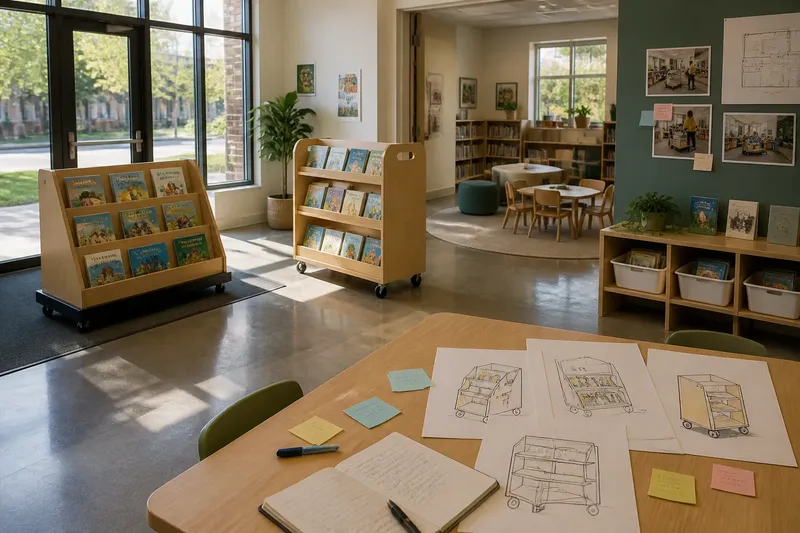
Consider an invented situation. A neighborhood library wants a mobile display for children’s books that can move between the entrance and a community room. Staff need to see the covers, move the unit without assistance, and keep a clear path through both spaces. The request arrives as “a cheerful, low wooden cart with three shelves.” The cart is plausible, but it is a proposed answer, not yet a reliable account of the need.
In this hypothetical walk-through, the design team does not discard the request. It separates its useful information from its assumptions, then makes a brief that can guide exploration without dictating the finished object. The distinction matters: a boundary should rule out unsuitable outcomes, not prematurely rule in one attractive outcome.
What is the project actually for?
The library’s purpose is not to acquire a cart. It is to make a small selection of children’s books easy to notice, browse, and relocate in two shared spaces. Naming that purpose changes what counts as a good solution. A fixed display near the entrance might improve visibility but fail the relocation need; a deep storage trolley might move easily yet hide the covers.
A useful brief gives the project a job that can be recognized in the finished work. “Encourage children to browse books” is a start, but it is broad enough to excuse almost anything. The team can make it more grounded by stating where browsing happens, who uses the display, and what a person should be able to do without staff rearranging it.
For this project, the team writes: “Help children and caregivers notice and browse a rotating selection of picture books in two library spaces, while allowing staff to move the display between them.” This sentence does not prescribe a cart, shelves, wood, or color. It gives the team a purpose to keep checking as possible designs change.
Start with the activity the design should support, not the object someone has already pictured.
Which constraints belong in the brief?
Constraints are not decorative details, and they are not all equally firm. Some describe conditions the design must satisfy: the display has to pass through the library’s doorways, remain usable in both rooms, and be moved by one staff member. Others are preferences: the library likes natural materials and wants the display to feel inviting. Treating both kinds as commands makes a brief harder to use than it needs to be.
The team asks staff to distinguish requirements from preferences. The staff member who first requested three shelves explains that the number came from imagining a compact cart, not from a fixed book count. The preference for a warm, welcoming appearance remains, but it need not mean wood. The practical conditions remain because the display has to fit the actual rooms and routine.
A concise brief can group information under a few plain labels:
- Purpose: Make selected picture books visible and browsable in two spaces.
- Users and setting: Children, caregivers, and library staff; an entrance and a community room.
- Must work: Staff can move it between spaces, and books can be browsed with covers visible.
- Known limits: The two routes and room layouts constrain its footprint and movement.
- Preferences: A welcoming character and materials that suit the library.
- Open questions: Whether books face outward, how they are grouped, and whether the display moves on wheels or in another way.
This structure makes a crucial distinction visible: a preference can guide judgment without serving as a pass-or-fail test. If a proposed design is welcoming but cannot move through the route, it misses a requirement. If it uses a different material but serves the purpose and fits the setting, the brief has not been violated.
When a requirement depends on a label, manufacturer instructions, or local rules, check the relevant source before treating it as settled.
How can the brief leave a real route open?
Openness is not the same as vagueness. “Make something engaging” leaves the team with no shared way to judge its work. “Make a three-shelf wooden cart” narrows the route before the underlying need has been explored. A stronger brief specifies the intended experience and practical limits, then makes room for more than one way to meet them.
For the library display, the team leaves its form undecided. The books might sit in shallow forward-facing ledges, in angled pockets, or in removable trays. The unit might roll, be carried in parts, or use another arrangement that fits the route. These are possibilities to examine, not promises that any particular option will work.
To keep that openness from becoming drift, the team agrees on a small set of questions for judging ideas:
- Can children and caregivers see enough of each book to choose one?
- Can staff move the display between the two spaces as part of ordinary setup?
- Does the design fit the routes and leave the rooms usable?
- Does its presence suit the library without distracting from the books?
These questions are deliberately about outcomes rather than style. They do not settle every design decision, but they help the team compare proposals on the same ground. One idea may make browsing clearer; another may make moving the display simpler. The brief gives the team a way to discuss the trade-off without pretending that a preferred look answers every question.
Leave decisions open when they are possible routes to the purpose, not when they conceal a requirement the team has failed to state.
What should the team explore before committing?
With the revised brief in hand, the team considers several distinct arrangements rather than polishing the original cart image. In this invented scenario, one concept uses angled book pockets on a narrow base. Another uses shallow trays that can be lifted out and repositioned. A third is a compact stand that stays in each room, with staff carrying only a selection of books between them.
The third concept reveals a useful ambiguity: does “move the display” mean moving one piece of furniture, or moving the book selection? The original request suggests the former, but staff describe the desired result as having books available in either space. The team returns to the brief and asks the staff to decide whether the display itself must travel, or whether the books may be transferred between stations. That clarification changes the design problem without changing its purpose.
The team also notices that “easy to browse” can mean different things. A child might need to see covers from a low position, while a caregiver may want to return books quickly. Rather than adding a decorative instruction such as “make it playful,” the team records these as use conditions to consider. The brief can stay short while the team’s working notes preserve the questions that still need attention.
Say the staff confirm that one display must travel, and that books should remain visible while it moves only as a secondary concern. The team can then compare the angled pockets with removable trays against the same purpose and constraints. The expected observable result is a clearer decision about which arrangement best supports browsing and staff movement, not proof that either design is already right.
This is the useful work of exploration: not producing more options for their own sake, but making hidden assumptions discussable while the cost of changing direction is still modest.
When should a brief change?
A brief should be stable enough to guide the work, but not so rigid that it protects a mistaken assumption. The library’s team does not revise its purpose because one concept looks appealing. It does revise a line about moving the display after staff clarify what needs to move. That is a change in the problem definition, not an excuse to abandon the original purpose.
It helps to distinguish a new finding from a new preference. If the team learns that a route cannot accommodate a proposed footprint, the brief’s constraints may need sharper wording. If someone simply prefers a different color, the preference can be noted without rewriting the project’s purpose. Keeping a short record of changes and their reasons prevents the brief from becoming a moving target that favors whichever idea was discussed most recently.
The team also avoids treating every unresolved question as a defect in the brief. Some decisions belong to the design work itself. The number of book positions, the exact arrangement of pockets, and the visual character can remain open while the team explores. The brief is doing its job if those choices can be made against clear needs rather than private assumptions.
Which brief questions clarify the boundary?
How do you tell a requirement from a preference?
Ask what would make the project fail if it were not met. If the display cannot reach the second room, it misses a stated need; if its material differs from the first preference, the team can still judge whether it suits the library. Record both, but give them different weight.
How much detail belongs in a design brief?
Include enough detail for someone to understand the purpose, users, setting, and limits, plus the decisions that remain open. Put measurements, layouts, or handling details in supporting notes when they need separate checking, rather than turning the brief into a specification for an answer not yet chosen.
Can a brief include a suggested solution?
Yes, if it is clearly marked as a starting idea rather than a requirement. For the library, “three-shelf wooden cart” can remain in the notes as the initial suggestion, alongside the need it was meant to serve.
What if stakeholders disagree about the purpose?
Ask each person to describe the observable result they need, then separate shared needs from preferences that conflict. If the disagreement affects the project’s core purpose or authority to proceed, resolve it with the people responsible for the decision before the team treats the brief as settled.
What does a useful boundary leave behind?
In the invented library situation, the revised brief does not select the winning display. It gives the team something more useful at this stage: a shared purpose, a short set of real constraints, and permission to examine different forms without turning every preference into a rule. It also exposes the question of what staff mean by “move,” which the original cart description had hidden.
The lessons are modest and practical. State the change the work should make; name the people and setting involved; separate musts from preferences; and leave solution choices open when more than one route could serve the purpose. When a brief feels either too loose or too prescriptive, inspect which decisions it has left unsupported and which it has already made on the team’s behalf.
A strong brief is not a miniature version of the finished design. It is a boundary the team can use to recognize a useful answer, including one nobody thought to sketch at the start.