Mind Map or Word List? Choosing a First Pass at Ideas
Choose a mind map or word list for early ideas by matching the format to your question, so useful possibilities stay visible without creating extra noise.
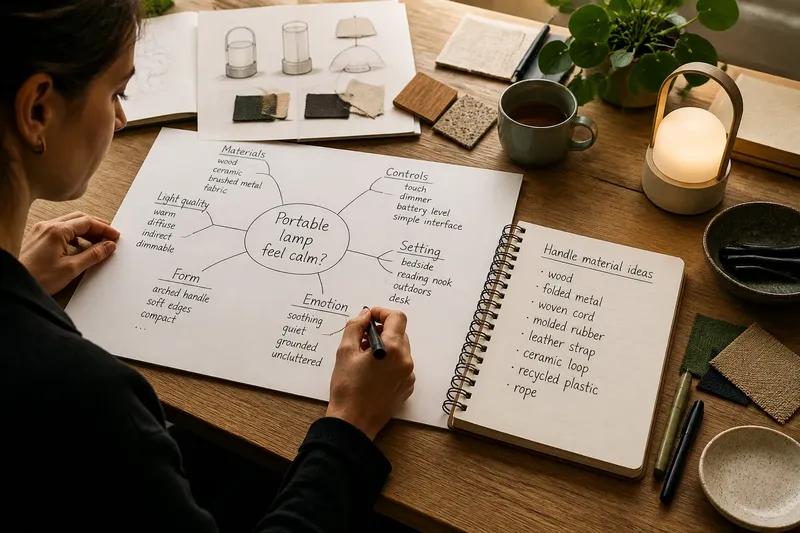
The common mistake in an early idea session is choosing a format because it looks creative, then asking it to do a job it cannot do. A mind map or word list can both capture possibilities, but one makes relationships visible while the other makes each entry easy to scan; the wrong choice costs attention, not just paper.
Use the question you are trying to answer as your first decision. The format should help you notice something useful, not become another design object to maintain.
1. What kind of question are you asking?
A branching mind map suits a question with connected parts: “What could make this portable lamp feel calm?” The center gives the session a shared subject, and branches can hold materials, light quality, controls, setting, or emotion. As one branch prompts another, the map records how the ideas arose, not only what they were.
A linear word list suits a question that asks for alternatives in a comparable form: “What could the lamp’s handle be made from?” Write “wood,” “folded metal,” “woven cord,” and “molded rubber” on separate lines. The entries are easy to scan side by side without the page suggesting that one belongs beneath another.
Before you start, write the question at the top or center. If it contains several different questions, choose one for this pass; otherwise the format will be blamed for a problem in the prompt.
2. When does a mind map help?
Choose a mind map when an idea may lead to several kinds of follow-up. A visual-design prompt about a neighborhood wayfinding sign, for instance, might branch into legibility, materials, placement, local character, and upkeep. Those branches can reveal that “make it welcoming” is not one design decision but several interacting ones.
Mind maps are particularly useful when the important work is association. A note such as “shade” might lead to “canopy,” then “gathering,” then “shared route.” The path does not prove that the resulting concept is good; it shows the route by which it entered the conversation, making it easier to revisit or challenge.
They also suit mixed visual and verbal thinking. A designer can add a tiny silhouette, an arrow, or a material swatch beside a phrase without forcing every thought into a sentence. Keep each branch label short enough to read at a glance.
Use a map when you need to see connections, not when you simply want a decorative page.
3. When is a word list the clearer choice?
Choose a word list when you need breadth, quick comparison, or a clean record of alternatives. If you are naming a small ceramic vessel, a list can hold “cup,” “bud vase,” “pourer,” “scoop,” and “desk weight” without quietly ranking one use as the parent of the others.
Lists make omissions easier to notice. If a team is collecting possible surface treatments, each line can be checked for a distinct option rather than a chain of related associations. The format also makes it simple to circle, cross out, group, or transfer selected words to another working page.
There is a practical advantage in collaboration, too. A shared list gives people a common place to add a phrase without requiring them to understand someone else’s branching logic. If several contributors are generating independently, separate lists can be combined later with less interpretation.
Choose a list when the entries need to stand on their own.
4. What should you do when the question is still fuzzy?
A fuzzy prompt often benefits from a short word list before a map. Collect the nouns, verbs, constraints, and impressions already attached to the subject, then look for a useful center. Starting with branches too early can make a half-formed question look more settled than it is.
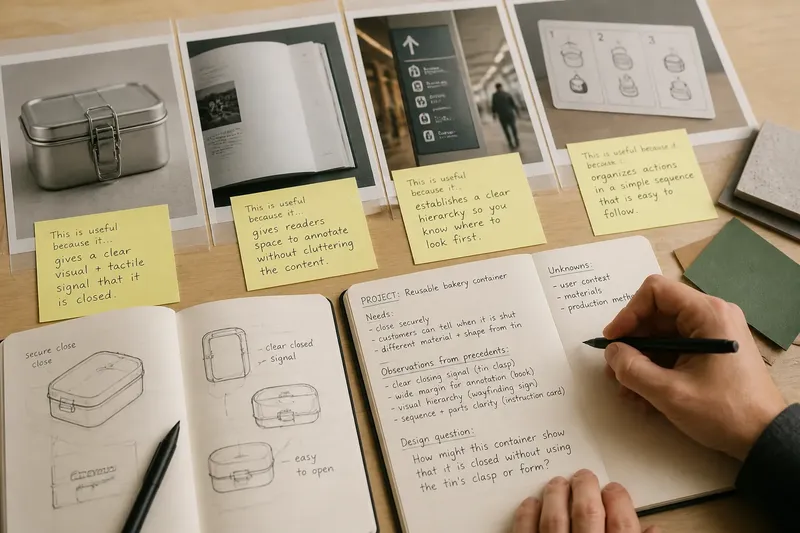
Imagine a designer asked to rethink a reusable lunch container, with no clearer direction than “make it better.” They could first list what “better” might mean: easier to open, less awkward to carry, simpler to clean, more pleasant to use at a desk. If the team then chooses “easier to open,” a mind map can explore grip, lid shape, hand position, and the container’s condition when cold or wet. The expected observable result is a set of specific opening-related possibilities rather than a page of unrelated improvements.
The reverse move can also help. If a map produces a crowded branch, lift its most distinct ideas into a separate list. That creates a comparison set without losing the connections that led there.
5. How do you keep either format useful?
Give the page one job and a visible boundary. For a mind map, keep the central question legible and use branches for meaningful categories, not every passing association. For a list, keep one idea per line and avoid combining alternatives with slashes; “wood/metal handle” is two possibilities wearing one coat.
Do not confuse a large page with a productive one. A map can become a tangle of long phrases, while a list can accumulate near-synonyms that merely change the wording. Pause when entries begin repeating, then ask whether the next useful move is to clarify the question, split a category, or compare a smaller set.
- Write the question in plain language before generating.
- Choose a map for relationships and a list for distinct alternatives.
- Keep labels concise enough to scan without rereading.
- Mark uncertain associations as possibilities, not decisions.
- Move selected ideas into a new format when their task changes.
These are working records, not finished concepts. Preserve an unusual phrase if it points somewhere interesting, but do not treat proximity on a page as evidence that two ideas belong together.
Which format fits your question?
Is a mind map better for visual design ideas?
It can be, when the design question involves relationships among form, use, material, and setting. A word list may be clearer when the task is to compare independent visual directions or surface options.
Can I use both a mind map and a word list?
Yes, if each format handles a different part of the work. A list can clarify the question or collect alternatives, and a map can explore connections among the most promising entries.
Should a mind map have only one central idea?
For a focused first pass, one central question usually keeps branches interpretable. If the page needs several centers, the prompt may contain separate questions that deserve separate passes.
How do I choose if I do not know what I am looking for?
Start with a short list of what is known, uncertain, and being sought, then select one question to pursue. If its answers seem likely to connect, map them; if they need to be compared as alternatives, keep the list.
What should happen after the first pass?
Choose the next format according to the action you need: a list for comparing candidates, a map for tracing relationships, or a sketch for examining shape and spatial arrangement. Do not keep adding branches simply because the page has room, and do not promote the neatest phrase just because it is easiest to read.
For an early idea session, the mind map or word list is only a way to make thinking inspectable. A useful first pass leaves you with a clearer question and material you can act on; choose the page that makes the next decision easier to see.